가족 사진 (FAMILY PHOTO)

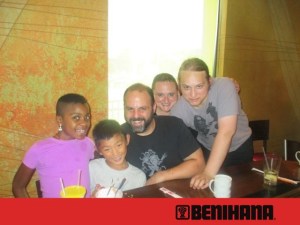
Last weekend was Béla’s seventh Gotcha Day, which we celebrated by doing electric go-karting the day before, and eating at Benihana the day of.

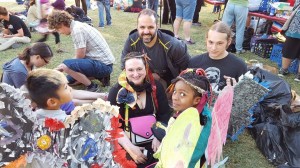
BENIHANAPHOTO

This is one of my favorite photos of us as a family of five. None of us really wanted our photo taken, nor were that ready. Claudia’s t-shirt is stained… we were sweaty as heck from sitting in front of a glowing hibachi for over an hour. And we made it clear that it was a “special day” for Béla, we instructed the staff at Benihana (several times) that Béla would not. Appreciate. Being. Sung. To. With. His. Dessert.

“Not even in Japanese?” our server asked.

Did she think he was Japanese? Did she just think any language other than English would make him like it?

(To be fair, Tucker got sung “Happy Birthday” to with a cake at a very populated art opening once, and being sung to in public isn’t high on his favorites list either, but he only let it happen under the condition that everyone in the room sang in a language other than English, simultaneously. That was fun.)

Others pictures of the five of us that I love include this one, taken in Tucson, Arizona, in 2015. We were there for the All Souls’ Procession Weekend, and Tucker had made an amazing — and terrifying — lantern to walk with, made with illuminated photos from his childhood, and his own drawings. It was burned in the urn at the end of Procession, but seeing him get to talk with people about what it represented was very empowering to watch.

image by CE Elliot, Procession of Little Angels, Tucson, AZ, November 2015.

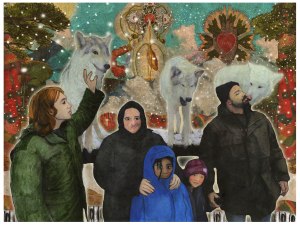
On our Facebook page for this blog, we have a cover photo that I thought was also visible here on the blog as a header image,, but as far as I can see, it isn’t. (I guess I need to look into that.) It’s a digital painting by artist Nina Barnes, based on a photo taken during Tucker’s 21st birthday weekend. (While many elements of the painting are fantastical, the wolves were really there.)

painting by Nina Barnes.

That is the only image of the five of us that hangs in our house. I read a Miss Manners column in my teenage years that said that displaying family photos anywhere but in private bedrooms was in terrible taste, and this has always stuck with me. (Since this isn’t a photo, it’s downstairs. I’ve also made exceptions for images of us where we are in full costume. Which isn’t an uncommon occurrence — and some of those aren’t hung and framed, but are glued to our walls.)

Béla had a nice Gotcha Day, but it was busy, with a rehearsal for the Bowie tribute show both kids have been getting ready for at School of Rock. And, Béla’s Gotcha Day, while being the day he came home, was NOT the day he met his sister; that happened the next day, on the 7th of August.

And so this year — seven years to the day after meeting one another as brother and sister, brought together from opposite sides of the globe — they were onstage together in Wildwood NJ, sweating metallic makeup, and performing music, together. While Béla mostly did cowbell percussion, and Claudia mostly lead vocals, they shared the mike as backup singers on “Modern Love”. Their involvement at School of Rock is something they relate to their “family-ness” in regard to Tucker; the suggestion to eat at Benihana came from a childhood birthday Tucker had enjoyed there. Some days, giving one another the very best of what we have to give one another, works.

Sometimes, this life is too beautiful for words.

At least for written words. It’s easily as beautiful as a couple of eight-year-olds yelping out the backup vocals to a David Bowie song while a patient, but somewhat perturbed teen tries to sing lead.

We are not perfect by any stretch, but we get high marks for enthusiasm.

Save

가족 사진 (FAMILY PHOTO)

RUDIE CAN’T FAIL

I was never a fan of the Fourth of July. Before we had kids, I’m pretty sure Ben and I just hid out and watched MST3K all day. Once we had the kids, we made a few very shallow attempts to “do something fun”, even if it wasn’t what anybody else was doing (I remember playing glow-in-the-dark mini golf in a nearly-abandoned mall, probably in 2012), but it was pretty halfhearted.

By the time Tuck had joined our household we had enough experience with him to know that he didn’t like the Fourth of July and all it’s “fun” either — he doesn’t like fireworks (not surprising), and the night of July 4th is the last time he saw his mother alive. The specifics of that story are his to tell when he feels like it, but for his first July living with us, in 2014, we had discussed in advance not only what we wanted to avoid “doing” (anything Fourth-of-July-ish), but whether or not we should “do something” in remembrance of his mother.

Suffice it to say that it is a pretty mixed bag of remembrance, and the acts of “mourning” or “celebrating” have not fit into it with any authenticity or comfort. It’s more of a getting through and holding space, and the actual anniversary falls in a murky area of a non-date — sort of the Fourth of July through the following morning. And this year is the first year that the fifth — the actual anniversary of the death — is not just part of the holiday weekend. I was surprised to find that Tuck had requested off from work long in advance of it, even knowing that the kids would be at camp and Ben would be working.

As for our Fourth itself, it is an evolving tradition that may in the long run have more to do with independence than remembrance. If you asked our kids “What does your family do on the Fourth of July?”, after three Julys of it (possibly the only ones they can remember), they would likely tell you:

— We stay home inside all day, except going out to do snake pellet “fireworks” in the afternoon at some point. We might watch a movie, but sometimes we don’t, although having MST3K on in the background is a distinct possibility.

— There is a lot of activity in the kitchen all day, most of it generated by Tucker. Mom gets out the big wooden salad bowl that she doesn’t even let anybody else wash, and there is always a Caesar salad. (“This is like a restaurant!” the kids had yelled, delighted, that first year, unaware until then that Caesar salad could exist in private homes.) Dad and Tucker work together like Amish men building a barn, to make a spanakopita. While there may be other kinds of food, there is always Caesar salad and spanakopita, and apple crisp for dessert, and apple crisp the next morning for breakfast on the fifth.

— There’s a special playlist of music for this day, and specifically for the time spent cooking and eating. Many of these songs are songs that we only hear on this day. It changes a little from year to year, but it is how the kids learned to do the Time Warp. (Music might get paused at points in the evening where we go outside.)

— If it’s not raining (like it did tonight), we will go into the park and do sparklers and other small combustibles, including perhaps one of those paper lanterns that immolate as they rise into the air, surely leaving their wire skeletons behind to kill an owl (I WON’T BUY THEM AGAIN. But I am using up the ones i DID buy, and there are a lot left).

In our household, this is the Fourth of July. I look forward to it more than I ever did before, and it has more personal significance than it did before, and it is amusing to see that the kids equate it with spanakopita and Outkast’s “Hey Ya”.

Our tradition is no tribute to anyone, except perhaps Tuck, who chooses to spend it feeding us all, but rituals for this day were originally conceived based on the mourning tradition of the “dumb supper” — where the dead are remembered through the preparation and consumption of their favorite foods, eaten without speaking, while listening to their favorite music. It’s a pretty good way to go, as far as these things are concerned — no speeches, no “sharing” of memories, nothing forced or sentimental. The work of making food, and whatever the music evokes. The expectations of those participating are minimal, as they should be in such complicated situations. The first year we did this, we promised one another that as soon as it felt weird — or wrong — for Tuck particularly, but for any of us, we would abort, throw everything in the garbage, and go out and get a burger. But that was never necessary.

As the menu and playlist are tweaked from year to year, we see that the changes we make are not made to make a thing more “right” or “the way it should be”, nor are Ben, the kids and I polite hostages to the straight and narrow of Tucker’s memory. We no longer have to carefully handle the pad Thai to which Ben is allergic, because none of us liked it enough to include it after the first year. I needed Fatboy Slim’s “Praise You”, to which I am allergic, struck from the playlist. Tucker added the Clash’s “Rudie Can’t Fail” this year, although I was pretty sure it had been there all along. Slice-and-bake Toll House cookies sounded right to Tucker; we had them.

This year, while the kids had one of their big concerts planned, Béla was being difficult and it seemed for a while that there would be no show. Claudia was panicked, and heartbroken, as she felt (unsurprisingly) that her contribution to things carried the day, and so she decided to go solo and unplugged — for four numbers, the last being a tribute to Tucker.

We were unable to use our giant neon sparklers and any of the assorted fireworks that Ben bought, or our owl-killing immolating lanterns, because of rain. Having been bummed out by a simpering Moldy Peaches song to which I am apparently allergic, I retreated upstairs temporarily. Tucker came up, and told me about this night eight years ago, when it also rained, as he was being driven back from saying goodbye to his mother. Suddenly it seemed like a good time to be with everyone else, eating apple crisp, and so we went downstairs. Recalcitrant Béla had simply put himself to bed four hours early, which was fine with all of us. We finished the Toll House cookies, and had apple crisp and ice cream.

RUDIE CAN’T FAIL

BIRTHDAY, PRESENT

It is my dad’s birthday. He is seventy-one.
 

I don’t think there’s anything to report about him other than that he is still a living organism. I say that while hearing his voice say it to me; that is the way that he talked. When his own mother died, he had reported to me from the viewing in Ohio that he and his siblings had sat in the first row, at least some of them choosing not to go up and look at the body. My recollection is that one of his sisters said, “Why should I? That’s not Mommy. It’s just a bag of skin and water.”


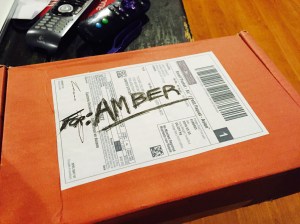
foramberbox


A few weeks ago Ben went away on business and Tuck and the kids and I stayed home. That evening, I was flopped out in the living room, pretty done for the day, staring at the clunky, oversized action figure left on the arm of the chair. It was Béla’s Incredible Hulk figure from his Avengers set.


I am a huge fan of the Hulk, and always have been. It was really exciting for all of us when the new comic series The Totally Awesome Hulk came out. Hulk is a Korean-American guy now. If you have told child-me  — and child-me had planned to adopt pretty much her whole life — “Hey, you are going to have a Korean son, and right around the time he is old enough to read comic books, there’s going to be a Korean Hulk,” I’d have been pretty amazed at the universe and it’s marvels (no pun intended).


I was looking at Béla’s Hulk and thinking of something that had happened a long time ago, and it was not an amusing prediction of my adulthood, where pretty much all my dreams would come true. It was a shitty memory from my childhood. I was looking at my son’s Hulk and was wondering, Have I ever told this story to anyone? Am I only remembering this right now or have I always known it?


And I may have been on the verge of thinking, all on my own, Should I tell this story right now? when I looked up and saw Claudia, who, with her perpetually thirty-year-old soul, was looking me dead in the eyes. Her expression was explicit in its message: Whatever that doll is making you think about, you better tell me, because the look on your face is not something I can go without understanding.


So. There was no further time to determine whether or not it was an “appropriate” story to tell, or whether I was “ready” to do it.
 

We were not a rich family when I was growing up. It was pretty unusual when a toy was purchased for me at a time other than Christmas or my birthday. I didn’t expect it to be otherwise. It happened occasionally — sometimes at my wheedling, and sometimes not. But at the time that I was four, in 1974, there was an Incredible Hulk action figure, and I really, really wanted him. Comic books were all I had had, and comic books were not enough. Having the actual physical Hulk. I wanted it more than anything.
 

Every trip to the mall required a walk-through of the Kay-Bee store, and I held that box a lot, and stared at it, and made it abundantly clear that I really, really wanted it, and maybe every time I did this I held out hope that this was the time that one of my parents would just take the box from my hands and walk to the counter to pay for it. It never was. In retrospect, I suppose I saw every trip to the mall as a fresh opportunity for that to happen, and I guess that means that in 1974, I was hopeful, and possibly even a self-renewing optimist.
 

I explained this much of the story to Tucker and the kids, who clearly had vivid expectations that this was going to end badly.
 

“So then,” I said, “It must have been near Christmastime, because my dad had to get a toy to put in the Toys for Tots bin at his work.”
 

“Oh no,” said Tucker.
 

Both of the kids looked frantic. They know what Toys for Tots is, but could not guess why this would be a turning point in the story, much less a troublesome one. But hey, so much for theory of mind deficit. Tuck saw it coming.
 

My dad had come home from work one day with a Kay-Bee bag, which was very exciting and unexpected. “No,” he said, “It’s nothing for you, I had to buy something to put in the bin at work –” at which point he opened the bag and showed me the boxed Incredible Hulk figure.
 

I was not a kid prone to displays of anger — which may very well have influenced, or have been influenced by, my love of Hulk, who I sort of saw as a giant, impotent green infant. But I freaked the fuck out. I had a honest-to-God four-year-old tantrum, because my dad had just brought home the toy I wanted most in the entire world, and told me it was for someone we didn’t even know.
 

Why he chose to bring in into the house and show me, I’ll never know, as he could just as easily kept it in his briefcase. Why he would go buy the one thing I wanted in the world, to contribute to the Toys for Tots bin in his office, is still as much of a mystery to me. For most of my life, and certainly in that moment, I saw it as intentionally baiting and mean.
 

I have tried, since understanding more about Asperger’s Syndrome, and recognizing later moments in my father’s life where he was genuinely surprised to find that the thing he had just done was considered hurtful — and seeing this happen to Tucker as well — to see this episode through that lens. Was it possible that my dad, who worked full time an hour away from our home as a registered nurse, had just finished his workday and popped into the toy store for this necessary errand and only recognized the Hulk figure as “a good toy”, not realizing (theory of mind deficit) how it would make me feel to know somebody else would get it?
 

To be honest, my father hated choosing things, and he had an absolute terror — terror with my father was generally expressed in exasperation and anger — of “getting it wrong”. It’s sad to think of this, because he did love to give gifts, but saw it more as a pass/fail task of retrieving the “right” thing than a chance to choose something. He had told me that this was a result of his own disappointment in gifts he had received as a kid, when he had asked for specific things but received something that was a weak approximation, and not “it”.
 

Into my adulthood, he persisted in seeing gift-giving as a test of his ability to identify the exact makes, models, and colors of items. He was frustrated during his dating years after his divorce from my mother, when he had girlfriends who would insist that all they wanted was for him to choose something that he thought they would like, rather than just having to tell him the bar code of the thing that was 100% sure to please them. For the few social events he would feel either forced to, or, mysteriously, want to attend, he would drive me utterly insane while he tried to puzzle out what was an appropriate thing to bring to a party. I would have to accompany him to stores in the Italian Market, choosing cookie trays or cheese and crackers and olives, insisting over and over and over that these were exactly the kinds of things I took to parties and they were the right things, but would invariably hear the morning after about how much was left on the tray and how he must have somehow made it wrong.
 

My dad loved the advent of the Amazon wish list. It solved all his gifting problems. For the first few years that my sister and our partners had lists available, my dad chose items from those lists for our birthdays and Christmas, reminding me repeatedly, at least, that it was me who had put the things on the lists, and therefore they must be right. Right?
 

At Christmastime, these items came in gift bags, because my dad did not know how to wrap presents, and after my mother had moved out, he was not going to learn.
 

The first year he told us to give the bags back so he could use them the following year, we thought he was joking. He wasn’t. We got the same Hallmark paper gift bags for perhaps three years in a row, with items from our Amazon wish lists in them.
 

Sometime during those years, having to choose items from our wish lists became trap for him. How did he know which were the items that we wanted more than the others? So he just started buying our entire lists. At this point, he had also given up the idea of gift bags, and gave us our Christmas gifts in Acme market brown shopping bags. He asked for those back too.
 

In this respect, I think it is entirely possible that my father did not see my reaction coming, when he brought that Hulk doll home in 1974. He may have just chosen a toy he knew somebody liked. It’s likely that having to do it in the first place was taxing, and likely that he did not expect to come home to a shrieking four-year-old (because honestly, it may have been the first, and only, time he ever did).
 

I was really mad that the Hulk was in the house, in a box, and was not mine. And I let it be known that I was angry. I was four.


My dad told me that my reaction to this situation had been so unreasonable, that not only was this Hulk not mine — my punishment for my outburst was that I could never, ever have a Hulk action figure.
 

It’s interesting to me now to realize that if my dad was buying for Toys for Tots, it was obviously near Christmastime. Not for a single second did I hold out the hope that Santa Claus would have a different outlook than my father on this situation. And I believed in Santa Claus. I just knew that if my dad said I wasn’t getting that Hulk, ever, that I really wasn’t. And that was all there was to it.
 

I told Tucker and the kids this story. Béla, as he is wont to do, said nothing, and put his hand over my hand.
 

“I am so glad that you did not make your parents my grandparents,” said Claudia.
 

“1974?” asked Tucker.
 

I realized that he was on his phone, and he held it up so I could see an image. “This one?” he said. There he was, the Seventies Hulk of my childhood.
 

“There,” said Tucker. “I got the twenty-two dollar one. Was that okay?” (Supported decision making in action — there was a time that I believed that if you gave Tucker a thousand dollars, he might just go purchase a thousand milkshakes. He’s gotten way better at money, but he still checks in, particularly when he’s spending it on other people, because his generosity tends to get the better of him.)
 

There had been a two hundred dollar version available for sale still in the box, but Tuck figured that was too much. He was disappointed, after purchasing the figure, to realize that the listing said it was missing part of an arm — he had not noticed that. He asked if  he should look for another one. I said definitely not. After 42 years, I see no reason that the Hulk, or anything, would make it to me in one piece, certainly not in defiance of my father.
 

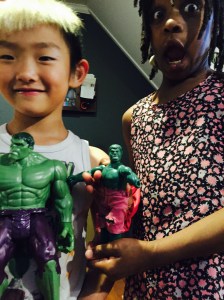
The box came today, on my dad’s birthday. I got to spend time with it before the kids got home, but they were also very excited to see it here. Béla went and got his larger, more articulated, fancier Hulk as well, and the Hulks interacted. Oddly, Béla’s Hulk was “Dad”. Tucker pointed out that my smaller Hulk was still obviously the older one. Nobody cared.


twohulks


I don’t think it would ever have been possible for my dad to see the way he treated buying gifts and treats for people as a “need for approval”. That need certainly did not carry over to other aspects of his life. My dad was way too abrasive and disinterested in the approbation of others to have a sugar-coated legacy.
 

But I can say now, that seeing the sugar-coating start to come off of other dead people, in flakes and chunks, takes its toll. Certainly on the people who have had to expend energy in keeping it there, or kicking the fallen-off shards out of sight. I see now what happens to the people who get stuck with that job; it’s a long one. If nothing else, my dad has spared me that. I’m sure he always knew I’d never have done it for him. In other ways, I did the best that I could.


BIRTHDAY, PRESENT

BLOCKING THE DEATH BLOW TO LOVE

“The nuclear family is a recent invention and a death blow to love — an unprecedented demand on a couple to be everything to each other, the family a tiny echo chamber: history one layer deep. None of the great virtues … is meant to be carried in isolation.” — Krista Tippett

We may have been considered a “non-traditional family” by some since before Tucker became part of us, simply based on the fact that our kids are adopted, and not white. But we functioned as any other “traditional” biological family as far as our roles were concerned. A mom, a dad, a big sister, a little brother.

When Tucker came, things became “non-traditional”, and that continues to be something we work through on a daily basis. I cannot say that roles changed, but that roles were spread out, and roles were added.

Tucker came to stay after a summer of what began as long, daily visits, where he’d text to let us know he had gotten home safely, even if he didn’t leave until 4 am. He had the code to the house, and got what he wanted out of the fridge on his own, and we sometimes came home from being out doing errands with the kids to find him here, but he was still essentially a visitor. Not a guest, but a visitor.

Over time, he supplemented his visiting activities — board games, movie watching, eating — with more reciprocal ones. Dog walking. Reading to kids. Making deviled eggs, birthday cakes, and dishes from his own childhood (overripe bananas saved from the compost by being fried in bacon fat; I’ve watched him not only make them, but blow on them to cool them before putting them in a bundled, mittened child’s mouth on their way out the door to school).

His long-into-the-night visits, where conversation got going after one AM, began evolving into more sleepovers. One night, as he went to bed on the fold-out couch in what was still sort-of the kids’ playroom, he asked Ben to wake him the next morning if we were all leaving; he did not, he said, like waking up in the house alone.

Late that summer, we had had a family meeting with the kids and said, Remember when Tuck was someone we just saw in the coffee shop, or who came to visit and help watch the house when we went away? It’s pretty different now, right? Well, we love Tuck and Tuck loves us, so he is part of this family now, and that makes him your brother.

More or less.

We were clear with the kids that this new undertaking did not make Tucker our son, nor us his parents. The kids knew who Tuck’s parents were, so that was not hard for them to understand, nor was it hard for them to understand why he might want to be elsewhere. At the time, it seemed mostly to be enough of a relief that he was staying to quell any other questions.

Claudia was particularly happy. Béla, however, at the time this pronouncement was made, gave off an unmistakable air of: But he DID just used to be that guy in the coffee shop. He can’t tell me I have to get in the SHOWER.

I was surprised it was Béla who was more thrown off. For months prior, we had watched Claudia go through a behavioral shift that was, in retrospect, clearly a reset of her system as she processed her change in family birth order. She was no longer the oldest kid. As though it were a biological adaptation, she went from being a tyrannical oldest sister to a little sister who could be wheedled, teased and terrorized. (Now she can be both.)

Nothing had changed in Béla’s order — he was still the baby of the family. And he himself had become Claudia’s brother simply by arriving by airplane. That was not an unprecedented way to get a brother. There was no missing his waves of resentment, though, and to this day, periodically, there still isn’t any missing them. A punch will be thrown at some point, I guarantee it. Béla may be ten, or sixteen, or twenty when it happens, but Tucker’s going to take it on the chin. Or block it. Who can say. The underlying unresolved issue remains, and it’s no longer But you were just that kid who watched the house when my family went on vacation. It is, I love you, but you aren’t my parent, and if you’re my brother, you’re going to take shit from me — because I don’t HAVE to respect you the way I’m expected to do for “real” grown-ups.

And frankly, he’s right. We sneak-attacked him with someone we said served the purpose of one title — “brother” —  but continually corrected him when he treated that person as one with that title would be treated.

We recently hung out with a a guy in his twenties, a few years older than Tuck but with a similar bent — a science guy, very driven, and very, very bright. Watching them talk together was fascinating. They were spouting stuff I could barely understand, both with big circles under their eyes (Tuck had turned in his final assignment of the term while walking down the street less than an hour before, laptop held out in front of him). This fellow, who we had met with to discuss the design and fabrication of dancing fans for the kids’ showcase for Parade of Spirits, showed us how a 3D printer worked, and we checked out a large laser cutter and some other cool things at a fabrication studio, and then we went to get something to eat.

“So are you learning something about this thing?” our new friend asked Tuck as we waited for our food, waving in the kids’ general direction. When Tuck did not seem to understand, he elaborated: “That thing that begins with ‘P’ and ends in ‘enting'”?

I cannot attest to what Tuck “knows” about parenting, but he certainly experiences it. At the same time, where Ben and I used to leave him with the kids alone for a few hours to go to dinner or something — we really don’t do that anymore, because Tucker hates it. I remember having him keep the kids in the hotel with him while Ben and I went on a “date” once in DC, only to come back to find Tuck nearly in pieces. When I reassured him he’d done a good job, he snapped, “Why? Because they’re alive? Because I’m alive?” (He learned that night that when the kids say “We’re hungry,” it’s far, far too late to look at the phone and see what pizza places are nearby, and to then order the pizza, and then wait for the pizza to come.)

Even at home, even given the most prefab of Trader Joe’s dinners and a movie to watch — it was a lot for him, if he was the only person on deck. It’s not something he has to be good at.

But will he spend eight hours with a kid cleaning their room? Yes. Does he play more board games with them than anyone else? Yes. When feelings are hurt at school, who is the person whose pep talk is going to matter most to the kid? Tucker’s. The fit of their clothes, the Hundred Book Challenge, the pulling of baby teeth, the first roller coaster ride and overseeing the first trip alone inside the corner store to buy candy — Tucker is on the inside track. He just needs to know there’s someone else around. While the interaction between Tuck and the kids is filial for the most part, it’s also more fluid than that.

The kids fluctuate with their terminology: when everyone is at home, we are simply “the adults”. When asked outright if they feel like Tucker is a brother or a parent, they have shrugged and said it’s somewhere in the middle. That is exactly how a friend I grew up with (and still know), described it at the time she was eight and I was six, about her own then-college-aged and married siblings.

Human fertility cycles can run long enough that you can’t use the clothes as hand-me-downs unless you’re trying to look retro. The fact that we put our family together out of existing humans, rather than humans we made, doesn’t necessarily change that dynamic. Still, when you fill out the Emergency Contact Forms for school, and they want to know the authorized individual’s Relationship to Child, we are all in agreement that no one is going to find “Kidnapee” to be a valid or humorous response. “Brother” it is.

Labels aside, I no longer have any idea how anyone would try to raise any number of children with just two people, or why they would. What can those two people possibly expect from each other at the end of the day? How can anyone fulfill their personal potential? It’s beyond division of labor; it’s intentionally limiting the pool of skills and talents. Recently, it was me who found the swollen lymph nodes behind Claudia’s ear, which might have gone unnoticed for days otherwise; it was Ben who zipped home to take her to the doctor to find out she was ok; and it was Tuck who was there at the end of it all, to play a board game with Claudia and a stuffed friend, and then read the story of Baba Yaga to both kids, in at least ten different theatrical voices.

Ben and I, pressed for options, could have managed both A and B; but instead we got to each take our specialty, and, when worn out from that, had someone ready to take over with C, which believe me, neither of us had the stamina for. That day isn’t remembered as the day Claudia had the swollen lymph nodes behind her ear; it’s the night Tucker read Baba Yaga in all those voices.

Though he too likes the multi-voiced storytelling and reading, Béla may wait decades to finally articulate exactly how furious he initially was at having Tucker move in with us. But, like the guy who showed us around the fabrication studio and let us play with the 3D printer — Béla, even at seven, can talk to Tuck about things Ben and I cannot. They discuss and explore computer games, statistics, manifolds. Tucker once, in a truly Hallmark moment of sentimentality and bonding, sat down with Béla and showed him all his Magic: The Gathering cards.

I could sense Béla’s initial enthusiasm — getting one-on-one “Tucker Time” is always in demand, and he was tipsy with joy. But hours went on, and Tucker, as many Aspies are wont to do, failed to notice the signs of Béla’s flagging tolerance. I suggested to Tuck that maybe Béla had taken in all the knowledge he could take in, so that the session should come to a close.

I asked Béla if he’d enjoyed his Tucker Time. “I had fun,” he said, “but after awhile, I started to miss the rest of my family.” We were in the living room.

Béla may have some appreciation of the things that Tucker can give him that we can’t as far as intellectual stimulation and entertainment. He is too young, and lacks the self-awareness, to see yet is that for the rest of us, time with him — Béla — is also a bit of an Everest trek. Things go on in much more detail than we might wish to entertain, and the air gets thin, and we, too, begin to miss the rest of our family. Without Tucker, Béla might be alone during those times, asked to go read a book or play on his own. With Tuck, he doesn’t always have to.

Everyone agrees, it seems, that “it takes a village” — but why does it only take a village to raise a child? What about the rest of us? Are all parents so completely fulfilled that they don’t EVER consider that perhaps it should also take a village — or more than just one other human — to get their jokes, to listen to the music they want to listen to, to have conversations they can’t have with anyone else? Yeah, we may have friends and co-workers and peers who may meet these needs — but once we are in our pajamas at home, does it all come down to one other person? The sound of Tuck and Ben laughing two floors down about something I know I don’t give a rat’s ass about is a wonderful feeling for me. It’s one conversation I didn’t have to smile through politely with either of them. We are all really different people. It is nice that we dispensed early with the idea that there were also supposed to be movies that all three of us needed to watch together on a regular basis. Because there aren’t. That’s pretty occasional. (And half of that time, involves the kids.) (And I prefer to do all my TV and movie watching entirely alone — something no one in the family really seems to understand or appreciate.)

There are times when I wonder just how “weird” our situation seems to outsiders, but, as Ben has pointed out, “I don’t know what counts as weird, more and more the distinction seems idiotically provincial.” He has a point — when I picture “outsiders”, I picture our neighborhood. In Philadelphia. In Pennsylvania. In the United States. Why is America so out of step with other countries who have more than two generations  — and more members of those generations — living together in a home? It isn’t just 1985’s misguided “USA for Africa” campaign that led us astray — the errant message seems to have lasted since then. The truth is, we aren’t the world.

Look up the noun coliving. (Feel free to add a dot org to it.) It’s happening for a wide range of people, for a wide range of reasons. For autistic people, it can be a boon. To live with people who love you and whom you love, with whom you can share great joy and family culture — and also receive assistance with supported decision-making (look it up, feel free to ad a dot org to it) — can be pretty cool.

Not all autistic people want or need it. Not all neurotypical people want to or can provide it.

In this house, we are pretty well matched. Read about it, and read about why others are doing it — living outside the construct of the nuclear family — and what it gives them. We are, as far as we are concerned, a nuclear family. We just got here a different way.

Claudia worries, and requires occasional reassurance, that Tucker is not, like other 22-year-olds, someone on the verge of leaving the nest. He is part of what makes the nest. She understands that his Asperger’s is part of his desire to stay here, rather than go live on his own, or with roommates. We talk about housing challenges for autistic people a lot at home, and are involved in projects to hopefully help address that issue in Philadelphia — but none of those projects are anticipated to mean new living spaces for Tucker.

She asks when we talk about his graduation next year, And then what? She remembers, vaguely, a time when he was far away. But Tucker’s not going anywhere anytime soon. We are a three-adult, two-kid family.

It is not always easy.

There are two men in this house.

Ask most married women; one is plenty. Ask most married mothers, who only have ONE man in their house, if they’ve ever felt that their husband/children’s father is more like an extra child; then just start laughing and clink your coffee cups together, because it is a rhetorical question.

Add one more man.

It is impossible for me not to be in some way “maternal” to someone who is twenty-four years my junior and who also comes with a considerable range of executive functioning deficits related to ASD. If I have to remind Tucker when to eat, sleep, and explain to him why he should do the homework that is due tomorrow before he does the homework that is due Friday (particularly since it is already one in the morning), then perhaps that behavior can be construed by someone who does not know many autistic people as “maternal”. It does not by any stretch make me feel like his mother.

I acknowledge his autistic identity, because it was so heartbreaking to see it minimized — and then, once it was a fact and not a conjecture, to see it staunchly ignored. People will value a structure, and tell you about how long its been standing and how many people created it, before they will question its integrity. Fuck that house. This is our house.

It’s been shitty here this month.

Somewhere between, or after, having one of our pet rats euthanized, and three trips to the doctor for Claudia’s temporarily compromised immune system, Ben and Tucker were looking for a  “good time” to tell me my dad had had a stroke. I found out about it before the good time came. Unlike both Tucker and Ben, from whom I literally do not even need to hide holiday presents — I have left labelled, unwrapped boxes in full view in common rooms, they see nothing — I notice a lot of things. I have PTSD. I am hypervigilant. I can tell when a picture has fallen off a wall and been replaced slightly askew. I can tell who put the leftovers away by looking at which containers were chosen to put them in. And I figured out, before they got around to telling me, that there had been a change with my dad.

It was a small enough stroke that he was considered to be “back to normal”. He is back at his house with his paid caregivers.

In a parallel universe, it would be here that my father would be dying. In my house, with my children.

We get to choose. You get to choose.

You just don’t get to choose for us.

During this extended not-good-time, a sick and run-down Claudia took a nap with an equally used-up Tucker, who has utilized naps as sensory breaks ever since coming to live here. (“I never needed naps before the feelings” is an offhand comment he made years ago, that I wrote down and transferred onto a large piece of fabric in rather rustic embroidery.) They lay nose to nose, and I could not see my daughter’s face, but saw Tuck’s. I never saw such a look of complete and unconditional love. It changed his features profoundly. He looked more relaxed, more adult, more experienced, more present. Very present.

Claudia studiously watched Tucker fall asleep, then snorted, wiggled, and fell asleep herself.

Tuck got up about twenty minutes later and went downstairs for the pizza Claudia had previously requested, bringing it up to the bedroom so that it was there waiting for her (we are no respecters of room functions).

When she woke up, she jammed a piece of pizza into her face, said “I’m gonna see what’s happening. I have no idea what I’m missing.” And went downstairs to find Ben and Béla. She left us sitting there, without a worry as to what, if anything, we might be missing. She knows we are all capable of figuring it out for ourselves.


BLOCKING THE DEATH BLOW TO LOVE

ESTRANGEMENT and your role in it

About a year ago I went to a group therapy intensive program, which met four days a week, for two-hour sessions. It was a big group; maybe fifteen of us, and one moderator/counselor.

In the takeaway, the one piece of lasting knowledge that I got at group was which brand of eye drops I should be buying (a lot of anxious people have dry eyes). I left the sessions exhausted, and did not complete the entire eighteen-session course. It did leave me, however, in a good part of town to do Easter basket shopping, which is what my aesthetic brain remembers most about the experience. If I think about “the time I went to group therapy”, I picture buying jellybean-print socks for Claude and an annoying little voice-synthesizer for Béla.

As with most talk therapy situations I have ever been part of, whether in groups or one-on-one, Al-Anon was far cheaper and more effective.

There is only one person from that group whom I remember by name, and about whose experience I can recall anything. His name was Keith. I got the impression that he had long ago lapped the eighteen-session format and was sticking around because it certainly wasn’t hurting anything. Whereas with most people in the group, the time spent in session was what I imagined to be their least “normal” time of day — the time when they did not have to “pass” or hold themselves together — for Keith, I imagined it was the reverse. While others were drying their tears and using their eye drops to try to go back to work or to take care of their kids, Keith was very open about the fact that group was the most structured time of his day, and even of his week. While some people talked openly about their clinical diagnoses, I can’t remember any particular label that defined Keith, but rather a hybrid of organic mental health issues, current medications for those issues which impacted his thinking and behaviors (he drooled, a lot, and only noticed it long after the rest of us had), and over a decade of serious drug abuse that had altered not only his ways and abilities, but his few remaining relationships.

He lived with his father. Independent living did not seem to be anywhere in the forseeable future. Although I had come in late to Keith’s story, he seemed to have no illusions about the fact that he was lucky to be living with his dad at all, however uncomfortable it might be for both of them, and however constraining. Keith had recently completed a six-week volunteer program with a local museum, and this had been successful, but he was casting about for more connections in a world where he wanted to make amends, and make a new life, with permanent, positive ties.

He was the Cosmo Kramer of the group, and said things that made the whole room laugh. When it was suggested that we have an evening session where our family members were invited as well, Keith was very enthusiastic. “Yeah!” he yelled. “Free food!”

“Nobody said anything about the center providing food,” the moderator pointed out.

“Then I’ll bring it!” Keith said joyfully.

There is one example of Keith’s sharing during group that has stuck with me so much over the past year that I can’t even really believe it’s only been a year since I first heard it. I have replayed it in my head that many times. Keith “went first” that morning in session, and he was not as buoyant as he often was. “I called my brother last night,” he said. “And I said to him, ‘I miss you so much, I just want to go to a hockey game with you. I want to see your sons, my nephews, and just watch a hockey game and have a good time.’

“And my brother said, ‘Keith, you fucked up so many years of my life, so many years of my kids’ lives, I have no idea if I’ll ever want to be in a room with you much less go to a hockey game with you, or have you see my kids,'” Keith reported.

Everyone in the room winced. There was nothing about Keith’s delayed affect that hid what a blow this had been to him, even though it seemed likely that this was not the first time this conversation had happened. “So,” he said. “I guess I’ll ask again, sometime.”

The group spent some time with this — after all, this wasn’t Al-Anon, where the rule of “no cross-talking” is enforced and no one may comment directly on anything anyone else says. In this group, lots of opinions and similar experiences (and eye drop recommendations) were offered. In the group’s post-mortem of Keith’s conversation with his brother, I witnessed more intimately than I ever had before the POV of the estranged family member who understood that a necessary step to ever building a bridge back to his family member meant understanding and accepting why that person did not want them in their lives, and did not need to give a promise date of when they would.

The only other place I had seen this kind of clarity was Al-Anon, where it was not uncommon to have an alcoholic guest speaker who, whether a year or twenty years sober, could sit with a smile on their face saying “I’m happy to be alive, and I would love to be able to have a conversation with my kid, but I understand why they wouldn’t want to and know I have no control over that.” These people, like Keith, had made an honest, accurate assessment of the damage they themselves had done, and recognized that it was bad enough that they did not want to subject their loved ones to the stress, the reminder, the possibility of it again.

It doesn’t always go this way. At home, we have seen — and we are pulling from three totally disconnected pools of dysfunction here — “I know that you don’t want to see me, but I want to see you, so come (to the place I am naming).” I’m not sure how a person gets to the point where they think that might work — or if it has worked, how they have rated their feeling of success after having procured what they wanted — but it really. Just. Doesn’t. Work. Keith, with one of the haziest minds I had ever seen in action, understood that he could never have what he wanted for himself — being at a hockey game with his brother and nephews — if, at the very least, his brother did not want it as well. Keith understood that trading meth for whatever prescriptions he was taking to keep his mental illness in check, and trying to keep busy, and live a productive life, did not count as free market currency and could not be traded in for time with his brother where years as a destructive force in the lives of his entire family suddenly disappeared and it was time to enjoy arena sports. Keith was honest about what he wanted, and had clarity in that what he was asking for was minimized — he probably wanted a lot more than just a hockey game — and was trying to ask for pretty neutral ground.

And he knew he wasn’t even owed that. His own recovery did not earn him a piece of anyone else’s. Who knows how many group or private therapy or twelve step sessions Keith’s brother had also sat through?

Around the time we adopted Béla, I had a one-on-one therapist I really liked. He was an unconventional therapist, so much so that my time with him ended abruptly only because he had lost his license to practice temporarily (I never found out why). His personal counseling was only part of what he did, and most of his time was spent doing family mediation with kids in the welfare and foster care systems, and (oddly, in retrospect), working with families who had children with Asperger’s Syndrome. He was the first person I ever heard use the term “Aspie”, which, coming from him, sounded rather rogue. He was helpful to me in understanding some of my dad’s inability to be a nurturing source for me — “THE WIRE MONKEY!!” I remember him shouting — and how it contributed to my own hypervigilance. He also tuned me in to the idea of restructuring relationships so that the labels they possess, and which they can never live up to, do not create a zero-sum game.

If he had a kid whose dad was a deadbeat who only showed up for three out of ten of their court-approved visits together, and the kid still wanted these visits to happen, one way to make them less disappointing was to reframe the relationship entirely. “This person is not capable of being a father to you; however, he can be a guy that you see from time to time, and have lunch with.”

If the kid could accept this — the permanent loss of having any expectations of this person as a “parent”, but could find a way to value the time with the person by thinking of them in terms of the actions they were capable of rather than of those that they weren’t — a good thing had happened. However, in these situations, both parties don’t have to agree to this change in terms. If the father in question was asked to consent to this change in expectations and said “I refuse to be seen as anything but a father! I demand to be invited to and be expected at all school concerts and recitals!” and still kept not showing up, absolutely nothing is gained — except a dysfunctional person is, again, somehow led to believe that their idea of how the world should work is the one that matters.

And with people like that, how things are seen — rather than the quality of private interaction with their loved one — carries a lot of weight. When a person makes life hard for someone they love, and that person changes their expectations of the relationship — when a loved one says “I am not asking you to stop drinking, but I would like to spend time with you only when you are sober, such as the time between when you finish work and go to the bar” — and the person in question treats this as an insult, rather than possibly the most loving thing anyone has cared to say to them in decades — they are worrying a lot more about managing public expectations than they are about having time of value with someone.

And, it is people who spend a lot of time and energy trying to manage public expectations, I have noticed, for whom the public’s expectations have long been formed. Nobody bothers the person with the reality of them anymore, because that’s never gone well. When you fail to conform to this kind of person’s code, their parry is, usually, to “punish” you — with less, or more difficult contact. You love me enough to no longer be able to stand seeing me drunk? Well fuck you then — I’ll consider that an act of aggression and refuse you that contact, and will further limit our contact to curt electronic communication.

That’ll teach them.

Be careful, when “punishing” your loved ones with the absence of you, that you aren’t clarifying just how much better life goes for them when you’re not in it.

This is what made Keith such a hero to me. He had no euphemisms for what he had been in his family’s lives. He was a disaster. He had cost money, years, dignity, peace, confidence, trust — he had been an enormous fuck-up, regardless of what twist of DNA had originally gotten him there. His brother did not need to reward Keith simply for not being arrested, rescued, resuscitated. His brother had his own experiences to deal with.

And I think it’s safe to assume that during Keith’s worst years, there might have been times that his brother was the one doing the offering, — of time, and attention, however modified from his original expectations of what a relationship with a brother should be like — and that it was Keith doing the rejecting.

Here’s the other thing that made Keith awesome. It was apparent when he told the story about his phone call with his brother, that it was not the first time his brother had rejected him. Not only did he have no plans to “punish” his brother for this transgression — his plan was to “ask again”. He didn’t mean the next day. He didn’t mean the next week. He didn’t plan to show up at his brother’s place of business to force him to confront the situation, or to enlist family or friends to “talk to” his brother and get him to smooth the way for him. His plan to “ask again” wasn’t a plan to try and change his brother’s point of view, but to try again to make himself available.

Because when you are the person people are trying to get away from, and you truly believe you’ve made a significant change that has a chance of stopping the damage from continuing, and possibly even repairing a relationship, it’s your job to say so. Even if all you can say is “I am here.”

Nobody in this house sits around wondering if the people nobody chooses to see have had epiphanies that have magically made them into people we are DYING to see, and we are MISSING OUT ON THE WONDERMENT. (Unless people have decided to fabricate epiphanies entirely out of spite, hoping someone will catch wind of it second hand and be oh so sorry that they did not keep calling and asking and hoping and are now wringing their hands at the thought that so much personal growth has gone on and yes, there are people I can actually picture more or less formulating an embryonic plan to do this kind of thing, but they haven’t shown much tendency to follow through on productive things, much less something this creative.)

It’s a pretty good rule of thumb: if a person can’t initiate a noncombative, nonintrusive way to express to you or show you how they’ve changed, and how far they have come — they haven’t.

And even if they feel they are helpless to change, or feel they don’t need to, but still want a way to show you that they can meet you at what they believe is the halfway mark, it really does help if they recognize that you, who aren’t asking to see them at all, do get to call the shots regarding the particulars of what may very well be a hypothetical meeting. My father, now long declared incompetent due to dementia, was officially estranged from our family when Claudia arrived. Prior to that time, I had regular contact with him for my entire adult life except for two years in my twenties, during which i managed to squeeze in a remarkable number of watershed dates — I had a close friend die of AIDS, I had another friend whom my dad had been very fond of have an unexpected pregnancy and child, and I had embarked on a truly unnecessary first marriage (which has, actually, served some purpose, in that it was so insignificant that the nine years it took of my life literally just reset when I left him, leaving me with the perpetual perspective that I am about a decade younger than I am).

I did not talk to my dad for two and a half years, and when I decided to, I sent him a letter saying I did. He sent a reply:

Dear Amber, I would very much like to see you. How, where, and when?

Dad (Drew)

I can tell bloodcurdling stories about my father. He did some truly damaging things to people, and he did them with the knowledge that he was doing them. But there were some things he did right, and that was one of them. He had been an asshole to me, and he had been abusive to me, and he had manipulated me, but he hadn’t wanted me out of his life. Because I had wanted him out of mine, the shots were now mine to call, if i wanted to call them at all.

I think it is possibly something that is clearer to adoptive parents than it may be to some biological parents (although I may also be entirely wrong about this, and it may just be clear to me, who happens to be an adoptive parent, watching the absolute wreckage of relationships of people who share genetic material), but nobody owes us anything. And in particular, our children owe us nothing. I have said it a million times in the last eight years but every hope I had for success in life has distilled down to I just want my kids to keep talking to me. They may wish I was a different kind of mother; they may eventually think of me as something other than their mother. I hope not. But the only say in it that I have is how I treat them every day. I cannot, without knowing that I am an enormous hypocrite and idiot, try to guilt them into changing their relationship with me or anyone else by telling them that “they’ve forgotten what ‘family’ means” or “they’ve forgotten who made them who they are” because no point on that vague and arbitrary compass points definitively at me. 

Which is better for navigation? Magnetic or true north? Magnetic north is always on the move. It takes some effort to follow it.

Or do you just want to follow what’s on the map, because you told everybody you had the map, and by God, IT’S A MAP — have you forgotten what maps DO? (MAPS do it — not you.)

(Please, do not think this way about maps. And if you do, don’t try to make any.)

I wonder if Keith has gotten to go to a hockey game with his brother and nephews. Maybe it did happen and it was just wretched for all of them. Maybe it went an entirely different direction, and turned out to be a family dinner that was okay, certainly better than nothing, way better than nothing, but led to no next dinner, and no hockey game, and no more acceptances to Keith’s offers. Maybe putting one shaky foot in front of the other for Keith’s brother showed him that he only had those few steps in him to take. It’s hard to make a mental picture of what it means to “wish for the best” when there is more than one person in the picture.

I don’t think anything is impossible. But I know that obligation is subjective, and very little is obligatory.


ESTRANGEMENT and your role in it

ORIGIN STORY

I cannot recall a time as a child or a teenager when I was not acutely aware that my friends were afraid of my father.

I was also afraid of my father, but when I was faced with the fact that my friends also felt that way, it made me feel very sorry for him. “Your dad is mean,” neighborhood kids would say to me when I was as young as four.

He was imposing-looking, tall, with a black beard and moustache, and black hair slicked back from a very high, protruding forehead. He wore frameless glasses, big lenses shaped like car windows, and he had very little to say – unless it was to correct others. “How would you like it if I stepped on you?” I remember him saying, quietly but tonelessly, to one of my playmates who was happily stomping a swarm of ants with her new Easter shoes. She and her sister had come to show me their new Easter dresses and bonnets, before they went to church. We did not go to church. I was embarrassed that my father was threatening to stomp my friends to death.

My childhood was not without happiness, and some of that can be attributed to my father. He loved being Santa Claus, and made elaborate – considering our modest household – displays of toys on Christmas morning; like a set-up in a department store window. All unwrapped, because “Why would Santa Claus waste that much wrapping paper?” This, and the poorer quality of gifts my neighborhood friends received, is what eventually tipped me off to the reality of Santa.

It had been embarrassing in my childhood to be punished physically by my father, but in my late teens, I no longer felt sorry for him when my friends reacted in horror. I was eighteen and standing with the refrigerator door open, looking for snacks and laughing with my friend. My father walked into the kitchen, and without a word, grabbed me by my hair and beat my head into the freezer door repeatedly, then walked calmly out of the room.


In my twenties, my father and mother divorced. She had been having an affair for years, and he finally threw her out. Once, again, I began to feel sorry for my father. He no longer hit me. He told me that he had no idea what people meant when they talked about “being in love with someone”, but that he supposed the closest he had ever come to it was how he felt about my sister and me.

It was around this time that he was made aware of a condition called Asperger’s Syndrome – it was relatively new diagnostically, and one of my father’s brothers had sent him some articles about it, because he was sure that both himself and his brothers had it. The uncle who had sent the article seemed least affected, while my father was in the middle. My other uncle had never moved out of my grandparents’ home, and was an obsessive vintage comic book, horror film, and toy collector, which had made him a fun uncle, but one with whom I still cannot recall making a single moment of eye contact.

I had never seen or heard of my father going to a doctor in my entire life, and he sought no formal diagnosis for Asperger’s. My father was a registered nurse, and knew his diagnostic codes. He worked for Blue Cross, and his job was to get claims denied. Due to his black-and-white thinking, and to his even tone of speech – he did not seem to get upset even when doctors, social workers, or family members were screaming at him for getting services denied – he was known, he told me once, as “The Dayslasher”.

Whatever his job might have given him insight into as far as therapies or interventions for people with Asperger’s Syndrome, he did not seek them. He identified with the low tolerance for small talk and social interaction, and the need for strict routine. After my parents divorced, my father ate the same meal, from the same kiosk, in the same food court, for over five years; when he decided to “switch it up”, it was only after months of talking about it, and he stayed with that dinner for another five-plus years. He identified cheerfully with the “obsessive” interests of people with Asperger’s Syndrome; regardless of the time of evening or how many times he had seen the episode, if NYPD Blue was airing on any station, my father would stop everything he was doing and watch it. To him, these were the traits of Asperger’s Syndrome with which he identified, and there was nothing that he wanted to do about them.


Shortly before my father’s father died in hospice, he told my father and uncle that he had a Do Not Resuscitate order, which he wanted to rescind. My father and uncle told him, practically, that he couldn’t. Whatever would be resuscitated was not something either of them had the resources to take care of. And, after all, there was my third uncle, still rattling around in my grandparents’ old house, which the siblings were now preparing to sell.

My grandfather understood what he had been told, and died. His house was sold, and my aunt enrolled my uncle in life skills classes, where he learned to shop for himself and balance a checkbook. He found an apartment, and was looked in on frequently by one or more of his nearby siblings.

My father continued on living alone in the house I had grown up in.


My contact with my father became less comfortable, and decreased, throughout my thirties. My husband and I saw him once or twice a month, for a meal or to visit an art exhibit, but not much else.

During this time we had begun the process of adopting a baby. While my father seemed excited about this eventuality, he seemed to have no understanding of the wear and tear the waiting process put on us, and me in particular. Because he seemed so unsympathetic and dismissive of my need to talk about how I was feeling, we saw less and less of him. Even our e-mail and telephone contact decreased. There was very little for us to say to one another.

By the time we were matched with a newborn baby in 2008, we had virtually no contact with my father, but left messages on his machine and with other family members so that he knew the baby had arrived. He did not respond to any of them, nor did he send a note, a gift, or a card. He did not acknowledge her arrival at all, and after five months of our attempts to contact him, I sent him an e-mail telling him that our relationship was officially over and I did not wish to hear from him again, ever.

There wasn’t much to miss. Being around my dad had only gotten more and more difficult over time. He had hated his job, which he had begun to do via “telecommuting” — working from home, so he had even fewer people to interact with. Much of his conversation with my husband and me, when it was not railing about the intolerability of others, was minutely focused on his food choices, and how if he went to the Bob Evans’ restaurant closer to his house it cost eleven cents more for the same meal at the Bob Evans’ five miles further away, but when you figured in the gas…

My father was no longer part of my life and had never been a part of my daughter’s. We adopted a son when our daughter was seventeen months old. Our babies grew into toddlers, and our life as a family of four felt very complete.


When our children were two and three, we were in need of a new babysitter, and asked around at the coffee shop we frequented. A nineteen-year-old young man was recommended, and he became our regular sitter. We liked him a great deal, and the kids loved running into him in the coffee shop, and were just as likely there to run into one of his three brothers.

One day, while getting my coffee, I had a conversation with one of the younger brothers, whose name was Tucker. It wasn’t much of a back-and-forth conversation; I did a lot of nodding, and eventually, had to just smile vaguely and wave goodbye. Our sitter was hanging out at a table outside the café. “Does your brother Tucker have Asperger’s Syndrome?” I asked.

“My mom thought he did,” our sitter said. Their mother, I knew, had then been dead for about three years. Everything about Tucker – a round-faced, light-haired, seventeen-year-old – reminded me of my father. His phrasing and intonation. The way he would sit awkwardly, saying very little, up until the moment I put my bag on my shoulder to leave, at which point he would launch into a diatribe — where my father’s would have been about television, Tucker’s was about chemistry. I would watch him solve a Rubik’s Cube, then politely ask someone to mess the cube up for him, and watch him solve it again.

Certain that if he once got a taste for it, he would become an adept and enthusiastic knitter, I offered to teach him. He looked as horrified as any seventeen-year-old boy would. I began carrying needles, and grey yarn – I was certain that it should be grey – in my bag, just hoping to find him bored enough one day that he would actually allow me to show him how. I had to replace the yarn twice, because of how fuzzed and matted it had gotten being carried in my bag. (He eventually gave in; it took two years.)

As we had become friendlier and more familiar with the other siblings and father of the family, I continued to ask this question of each of them: “Did you ever think maybe Tucker has Asperger’s Syndrome?” and the answer was always vague but seemed to suggest Sure – but isn’t there enough else to worry about?

When one of his brothers or his sister would complain to me about Tucker’s “obliviousness” – and even lack of “feeling” over their mother’s death – I would ask, “Have you thought about this being a real possibility for him, having Asperger’s? And that may be something with which he needs help?”

One of Tuck’s brothers once rattled off the list of grievances about Tucker by text, and I questioned, “And who would you rather be today – you, or Tucker?”

“Do you even have to ask?” he answered.


My husband and I both turned our focus from asking anyone else who knew him to validate our concerns about Tucker, to talking to Tuck himself about it. Yes, he said, he’d remembered his mother saying that she thought he had Asperger’s. It had never come up in the context of diagnosis, or intervention, or services. From what he had seen and read, it had long sounded to him like he had Asperger’s Syndrome, and he recalled having told people so in the past. But nothing had ever been “done about it”.

I had, for as long as I had known Tuck, told him that he reminded me of my father. He knew that we were estranged, and that there was good reason to be, and I was careful in my emphasis that it was just the manner of my dad – a comfortable quality – that Tucker carried. And this was true; if you asked Tucker if he wanted to do something with you, you could be sure his answer was honest. There was never any second-guessing or social “politeness”. I knew what I was getting with Tuck, and knew what it was okay, or not okay, for me to give. The first time he had housesat for our family while we went on a weekend vacation, I had brought him back a star-shaped paper lantern; he returned it to me, saying that it seemed only to have “sentimental value” and that he didn’t have the room for it. Even this felt safe and homey to me – this disregard for my gift, and inability to see how it might hurt my feelings, reminded me of my unsentimental father.

My husband and I offered to pay for the diagnostic process to find out if he had Asperger’s, if it is what Tuck wanted to pursue. I wanted to know. It would “explain” so much about Tucker. It had about my father, and he’d never even stepped in a doctor’s office.

But, unlike I had ever done with my dad, I now wondered what the next step was – if Tucker had Asperger’s, what happened next? What was he going to get next? And from who? Would there be a pamphlet, a book, a support group?

We had not even begun to answer the question. Tucker was home from his first year at college and spending a lot of time at our house. One morning we got the kids to preschool, I meditated and checked my e-mail, and found from a family member that my dad had been diagnosed with dementia. He was still driving his car, and doing some things independently, but the prognosis was obvious.

I called my husband and told him, and continued using my phone to grab every shred of a lifeline I could. I did not want to be alone. Within minutes I had lined up three meet-ups with friends for that day, but the first did not begin for a few hours. I knew I could get through that much time, but… I realized, Tucker, who had open-door privileges at our house, could walk in at any moment. I was shaky and crying, and thought that even if I didn’t see him until later, I’d be shaky and crying then, too.

I knew it would confuse him to see me upset, so I texted him. I said I had just gotten some big and bad news, and when he came over later in the day, could he sit down with me for a little while so I could fill him in?

He asked if he could just come over right away.

And so Tucker was the first responder, in person, to the news of my father’s dementia diagnosis. I did not even tell him; I handed him my phone so he could read the e-mail I had received. I cried on his shoulder, and I thought, What a creep I am – putting all this on a nineteen-year-old.

But he was Tucker, and so when I put it on, it didn’t really stick. “Clinical”, “robotic” – these were words that had been used to describe Tuck, by people who knew and liked him. Tucker was the friend who was there for me when I found out about my dad, and he was empathetic, but not emotional.

I had coffee dates with friends to get to, and spent the day telling and retelling, and when I got home that evening, Tuck was hanging out here as expected. It was Tucker, in the long run, who was easiest to talk to about the ambivalence of losing a very difficult parent, and it still is.


Meanwhile, no one had forgotten our family agreement to put Asperger’s “on the table” at home. We were novices; all we had decided to do was to let Tucker know when he was doing things that made communication difficult, or made us feel left out or underappreciated. Beginning to talk about these things – how important it was to us to have him come in and greet us before going back to his computer, or to stop at some point during his six-to-ten hour gaming sessions and chat – made a big difference.

But as much as we believed we were going to educate ourselves and Tucker about Asperger’s Syndrome and whether or not he “fit” its mold, it was Tucker who began to tell us things we never knew. We had until that point viewed it solely as a social and communication issue – the “price” he paid for his high intellect. We had few clues about the sensory issues Tucker faced on a daily – hourly – basis. (He had once complained about watching “Breaking Bad” because it was “too orange”.) He told us how sounds, light, and the pace of the world in general affected him. I certainly understood more about why his puzzles and games were ways to cope with social and family pressures, not just mindless retreats. I taught him to knit, and he took to it very quickly, and with great interest.

I saw now how frustrating it was for him to be asked a question, and then a follow-up question and another follow-up question – something I did regularly – before he’d been able to answer the first question at all. (Now I know about the “eight-second rule”, and anyone who communicates with an autistic person should, too.) When his skin-picking and scratching at his arms and legs became something we felt was not too delicate to mention (by this time, had transferred schools and was living with us full-time), we found sensory substitutes – small “fidget” toys with moving parts – that helped him leave his fingers and legs alone long enough to heal.

I began searching for parents of children, adult children, with Asperger’s, and was given “tips” that sounded bizarre and severe – and yet, they would unlock hours of calm and openness where Tuck might otherwise be tied in knots, whether from academic pressure, the new challenge of living with two five year-olds, or anything. “Surgical brushes,” a mother had told me, giving me the link for where to buy them. I put them in Tucker’s Christmas stocking. He had rubbed them on his arms, and shrugged.

Two weeks later, after too much computer game time and the harsh realization that the kids were home for another snow day, he seemed to just stall out; his eyes got distant, his face blank. “Let’s try the surgical brushes,” I said, and winced as I watched him rub them, slowly and with a lot of pressure, against his face. When he opened his eyes minutes, later, I did not have to hear a word from him to know what they had accomplished.

“Where did those come from and what else do they sell, because I want it,” he said.

It was a gift, I’d dare call it a blessing, to be able to communicate with Tucker about what Asperger’s felt like for him, and what we could do as a family to make things easier – to understand, and to be understood. It was also a hard slap in the face to recognize that all of these sensory battles that Tucker had waged – rooms that made him want to disappear, conversations that happened too fast to participate in, intolerable textures in food and clothing and scents that lingered on the skin – were all things that my father had experienced. My father had identified with certain aspects of Asperger’s, but he had never mentioned any of the sensory ones. I believe now that he must have been experiencing them. And, knowing my father, they had made him feel weak and confused, but he never would have sought help.

Clearly, like any autistic person, my father had meltdowns. Like Tucker. Tucker’s meltdowns, as with many autistic people, were characterized by anger turned inward. There were times, he had told me, when he looked at a room and saw every surface upon which he might bang his head as “lit up” in red, as though beckoning to him. It was heartbreaking to think of Tucker feeling this way, but also terrifying to realize that I knew exactly what my own father looked like when things were “lit up” for him, and what would happen to me when they were.

Through living with Tucker, I was been able to, in retrospect, better understand my father. The answers for so many questions became apparent. I do not think he was ever able to understand, manage, or forgive himself for his own coping behaviors, but watching Tucker cope and survive, and thrive – and feeling the full range of emotions towards Tucker, from admiration and love to irritation and fury and forgiveness — allowed me to experience empathy for my father where I might otherwise not have been able to.

Slightly more than a year after I had received notification about his dementia diagnosis, I received word that my father had colorectal cancer. While initially given treatment, he was combative, and so a court hearing took place declaring him incompetent. He was appointed a guardian. It was decided that the cancer would go untreated but for palliative care, so that my father’s now seemingly endless life might end sooner.

As of this writing, my father’s cancer seems to have taken on his personality; quiet, unmistakably present, and sucking all the fun out of everything, but with no intention of leaving. The last I heard any news of him was an itemized expense report sent to my by hand courier, detailing his very modest yearly expenses. It arrived Christmas Eve morning.

And on Christmas morning, Tucker was here – and is here – home. I spend more time reading articles about autism than I do anything else on social media. Tucker, pursuing an undergraduate degree in neurochemistry, has just been offered the final co-op position of his five-year degree program, at the University of Pennsylvania’s Mindfulness, Stress and Health Lab, where he will assist in investigating the benefits of mindfulness for people who need those benefits. Like people with Post Traumatic Stress Disorder – a diagnosis I have carried for eight years, and have been earning for forty-six.

I hope this is the year that my father dies.

A few weeks ago, taking our kids to a new comic book store, we drove past one of Tucker’s childhood homes. As we idled outside, he pointed to windows and doors, describing what was inside. “Is this the house where your mother died?” I asked. He seemed to have to think about it for a moment. “Yeah,” he said.

At home later that evening, I said that it had been hard for me, seeing that house. “Why?” he asked, genuinely surprised. “Because it’s the house your mother died in!” I said. And he thought again. (I counted to eight.) “Yeah,” he said, “but a lot of other stuff happened there, too.”
ORIGIN STORY